
Medical equipment management

Full control of yourhospital equipmentfleet

Equipment history file

The platform that brings together inventory, maintenance and an equipment history file for every device in the institution, from any manufacturer.

What KIBBO is

KIBBO is the platform that manages the medical equipment fleet of a healthcare institution: inventory, maintenance, history and traceability, whatever the manufacturer of the device.

How it works

KIBBO open on a laptop.

THE FLEET TODAY

Problems KIBBO solves.

The same problems recur in any medical equipment fleet managed without a single platform.

Without KIBBO

The fleet inventory is not reliable.

The real inventory ends up split across spreadsheets, paper records and the knowledge of a few people. The institution cannot say how many devices it has or where they are.

With KIBBO

KIBBO brings the fleet into one list: serial, QR, service, status and last activity.

  1. Without KIBBO

    The fleet inventory is not reliable.

    The real inventory ends up split across spreadsheets, paper records and the knowledge of a few people. The institution cannot say how many devices it has or where they are.

    With KIBBO

    KIBBO brings the whole fleet into a single list: each device with its serial, QR, service, building, status and last activity. The entire fleet, searchable without asking anyone.

  2. Without KIBBO

    Equipment history files are scattered.

    Who intervened, what was replaced and when it was calibrated are data that stay in papers and emails. The history gets reconstructed once the device has already failed.

    With KIBBO

    KIBBO builds an equipment history file for every device: the profile with brand, model and serial, plus a dated log of events and work orders, signed by whoever logged it.

  3. Without KIBBO

    Preventive maintenance lapses unnoticed.

    With no calendar to anticipate due dates, preventive maintenance turns corrective. An emergency intervention costs more than the same task planned ahead.

    With KIBBO

    KIBBO tracks every preventive task with its date and status: the list flags whatever is past due as "Overdue," and the due date is seen coming before it turns corrective.

  4. Without KIBBO

    Service providers are in no record.

    Each provider's details stay scattered across emails and personal spreadsheets. When a device stops, tracking down whoever services it already eats into repair time.

    With KIBBO

    KIBBO brings the fleet's service providers into one place, each with its province and city, whatever the manufacturer. There are many providers; the record is one.

  5. Without KIBBO

    There is no documentation to make the case.

    A budget request, an audit or a claim all end at the same point: showing the record. With no documentation, the discussion is lost before it starts.

    With KIBBO

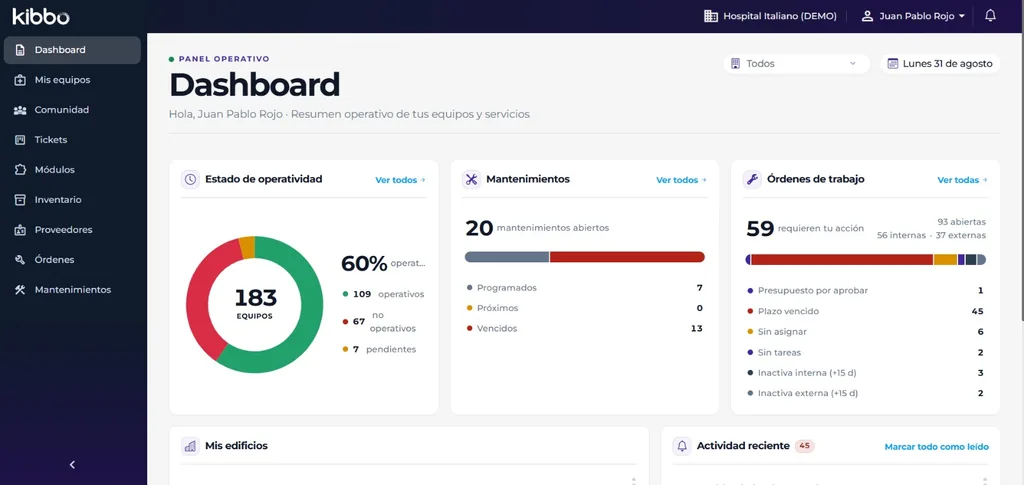
    KIBBO sums up the fleet's operational status on a dashboard: how many devices are running, the open maintenance and the orders that need action. The data to make the case, in plain view.

  • The whole fleet in one list
  • One equipment history file per device
  • Preventive maintenance, on time
  • Any manufacturer, one place
  • The data to make the case

WHO ALREADY USES IT

What users say

See the full case
Fabián ChiccoFabián ChiccoRating: 5 out of 5Biomedical EngineerCordoba Municipal Emergency Hospital
«A nosotros (Kibbo) nos ayudó a tener organizada la información e identificar qué equipo conviene arreglar o dar de baja. Además permite visualizar incidencias desde cualquier dispositivo y actuar de modo rápido»

Translated from Spanish“It (Kibbo) helped us keep our information organized and identify which equipment is worth repairing or retiring. It also lets us view incidents from any device and act quickly.”

Watch the interview


Carla TaddeiCarla TaddeiRating: 5 out of 5Head of Biomedical EngineeringCarlos G. Durand General Acute-Care Hospital
«Práctico, muy simple y, sobre todo, muy intuitivo.»

Translated from Spanish“Practical, very simple and, above all, very intuitive.”

Watch the interview
Ismael BoninoIsmael BoninoRating: 4 out of 5Head of Biomedical EngineeringBelgrano Adventist Clinic
«Una "pata" importante para el departamento: nos hace ahorrar mucho tiempo y nos organiza mucho mejor.»

Translated from Spanish“A key pillar for the department: it saves us a lot of time and keeps us far better organized.”

Watch the interview
Juan Manuel ÁvilaJuan Manuel ÁvilaRating: 5 out of 5Head of Biomedical EngineeringSan Camilo Clinic
«Es muy fácil de usar. De los usuarios que lo usaron, ninguno tuvo problemas, y nos sirve para las necesidades de la clínica.»

Translated from Spanish“It's very easy to use. None of the users who tried it had any trouble, and it fits the clinic's needs.”

Watch the interview

PLANS

The plan is chosen by the size of the fleet.

KIBBO is contracted by plan, based on the number of devices, users, sites and storage. Prices are published and each plan is arranged with an advisor.

The equipment fleet, managed with KIBBO.

KIBBO's operational dashboard on app.kibbo.io: the equipment fleet with its operational status, its maintenance and the work orders.

app.kibbo.io

KIBBO screen on a phone: the form for reporting an issue with a piece of equipment.

Frequently asked questions

How do you start using KIBBO?

You choose the plan by the size of the fleet and arrange it with an advisor, from the button on each plan. KIBBO runs in the browser, with nothing to install. Support and training are available whenever the institution needs them.

Does KIBBO have a plan at no cost?

Yes, two, with the same limits (up to 1,000 devices, 3 users, 1 building and 50 GB). FREE · DEMO: any institution can use it for 60 days at no cost; when the trial ends, the account is deactivated or moves to PRO. FREE WITH LEEX: included and never expires for institutions that have purchased LEEX equipment. An advisor activates both. The PRO plan is US$ 89 per month plus tax.

Does KIBBO work with equipment from other brands?

Yes. KIBBO manages the whole fleet whatever the manufacturer of each device, and it does not require buying equipment to use it.

How long does it take to load the equipment fleet into KIBBO?

It depends on how many devices the institution has and how they are recorded today. Loading can be done independently from day one, without waiting for anyone. Alternatively, the KIBBO team goes to the hospital, loads the fleet device by device and sticks a QR label on each one: this is a separate service, arranged when the institution needs it.

Who is behind KIBBO?

KIBBO was created by LEEX and is a trademark of LEEX LLC, with its registered address in Miami, United States. LEEX has installed and serviced medical equipment since 1986: 40 years of experience, over 30,000 devices and a presence in more than 7 countries. KIBBO came out of managing equipment every day and, even so, it works with equipment of any brand.

What happens to the data loaded into KIBBO?

The data loaded into KIBBO belongs to the institution that loads it. The Trust and security page details how that data is handled and the terms of use.

What is medical equipment fleet management?

Medical equipment fleet management is the practice of keeping the full inventory of a healthcare institution's equipment together with its status, its location, its intervention history and its preventive maintenance schedule. It is the discipline clinical engineering deals with, and it is what KIBBO administers on a single platform.

What is an equipment history file for a medical device?

An equipment history file is a device's complete record: its profile with brand, model, serial and UMDNS code, plus a dated log of everything that happened to it, with notes and work orders signed by whoever logged them. In KIBBO every device has its own, consulted from the desktop or from the phone by scanning its QR code.

Does KIBBO replace the hospital's management system?

No. KIBBO manages the medical equipment fleet: what equipment exists, where it is, what was done to it and when its next maintenance is due. It does not handle scheduling, medical records or billing. It coexists with the institution's management system rather than replacing it.

How is it different from a spreadsheet?

A spreadsheet keeps a list; KIBBO keeps the state of the fleet. It flags which maintenance is overdue, keeps each device's dated, signed history, is consulted from the phone next to the machine, and does not depend on someone remembering to update it.

Who is KIBBO for?

KIBBO is built for the clinical engineering, biomedical engineering and maintenance teams of healthcare institutions that need to know what equipment they have, what state it is in and when it is due for maintenance. It is also for hospital and clinic management and administration, who see the fleet's state on a dashboard, and for the technical-service providers that service that equipment.

Does KIBBO handle biomedical equipment maintenance?

Yes. Inventory, equipment history files and maintenance of biomedical equipment: what each country calls clinical engineering, biomedical engineering or healthcare technology management. The department's name changes, not the job: knowing what equipment exists, what was done to it and when the next preventive maintenance is due. KIBBO records it for every device, from any manufacturer.

Does KIBBO help answer an audit?

Yes. Each device keeps its dated, signed history of notes and work orders, and the dashboard sums up the fleet's operational status and overdue maintenance. That record is what an audit, a claim or a budget request asks to see.

Is KIBBO a CMMS or a GMAO?

Yes. CMMS (Computerized Maintenance Management System) and GMAO (its Spanish acronym) are two names for the same category: the software that administers the asset inventory, preventive maintenance, work orders and the history of each device. KIBBO is a CMMS specialized in medical equipment, and those four functions are what it solves.

How much does KIBBO cost?

The PRO plan costs US$ 89 per month plus tax and covers up to 3,000 devices, 5 users, 3 buildings and 200 GB. For larger fleets, the ENTERPRISE plan is defined to measure. There are two at no cost, up to 1,000 devices: FREE · DEMO, 60 days for any institution (then the account is deactivated or moves to PRO), and FREE WITH LEEX, included for institutions that have purchased LEEX equipment.

Do I need to install anything or run my own server?

No. KIBBO is a web application: it runs in the browser, with no installation or servers at the institution.

In which countries can KIBBO be used?

In any country. KIBBO is a web application in Spanish, accepts international payment methods and offers online support in Spanish and English. Any institution, wherever it is, can sign up and start loading its fleet the same day.

Does KIBBO access patient data?

No. KIBBO records equipment, not the people treated: its privacy policy expressly states that it does not collect sensitive data, a category that Law 25.326 defines as including all health-related information. The data the institution loads belongs to the institution.

Can I remove my data if I stop using KIBBO?

Yes. Consent for data processing can be revoked at any time, and the data subject may request access to, correction of or deletion of their personal data. The privacy policy details how to do so. Revoking consent means the platform's features can no longer be used.

Can I export my institution's data?

Yes. KIBBO has an API to export and import data, so the inventory, the history and the maintenance can be moved to another system or integrated with the one the institution already uses. The data loaded into KIBBO belongs to the institution that loads it.

Does KIBBO sell or share my institution's data?

No. The terms and conditions establish that KIBBO does not transfer or sell personal data to third parties. The only declared exception is the technology providers tied to storage, maintenance and infrastructure security: they receive information to sustain the service, not to use it. It is a contractual commitment, not a statement of intent.